Chapter 02 Motivation
Objective and approach
Objective, guiding questions, approach according to VDI 2206 and scope delimitation
The objective is a platform on which a real PLC works against a computational model instead of a board. Three guiding questions structure the thesis; development followed the V-model of VDI 2206.
Objective
The objective of the thesis is a digital twin as a simulation platform: a real programmable logic controller (PLC) does not work against a board but against a computational model. The controller does not notice this. Its outputs still sit at 24 V, its inputs still receive 24 V; the signal merely originates from a simulation instead of from a slide switch.
Guiding questions
Three questions run through the thesis:
- Coupling: Can a plant model be coupled to a compact controller in such a way that the loop is closed?
- Model quality: Is a model built from a mass balance and an energy balance sufficient to reproduce the behaviour of a heated tank convincingly?
- Architecture: Does an architecture without external services also hold up with several plant models?
The evaluation is found in Chapter 11.
Approach according to VDI 2206
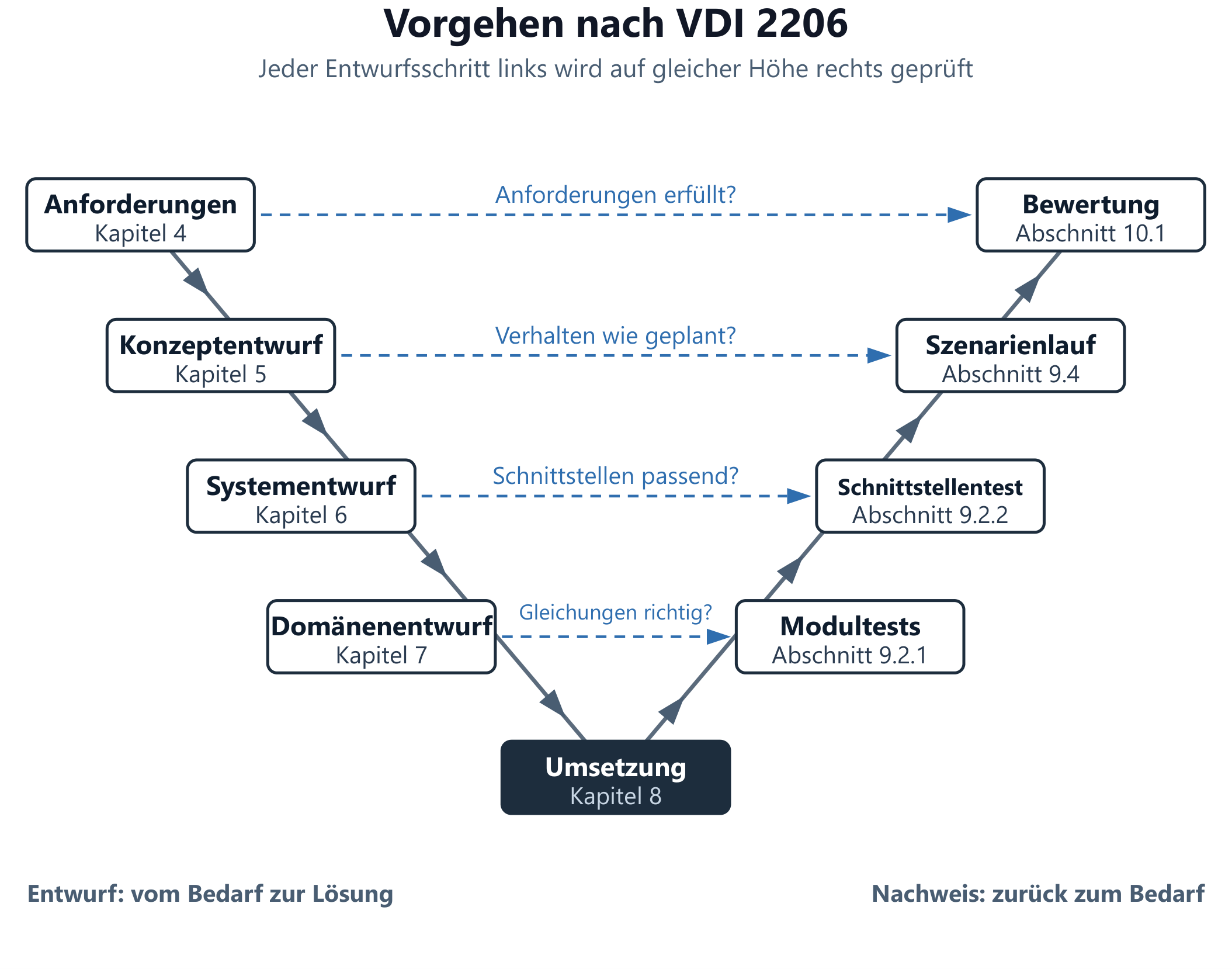
Development follows the V-model of the VDI guideline 2206 for mechatronic systems (Fig. 15). Each design step on the left is assigned a verification on the right at the same level: the evaluation to the requirements, the scenario run to the concept design, the interface test to the system design and the verification of the equations (module tests) to the domain design.
Scope delimitation
Not part of the thesis are control design, safety certification and operation on a real plant. The comparison with measurement data from a real tank deliberately remains open (Chapter 11). For the conceptual classification as a digital twin see Chapter 3.